
Text to Image
Split-Era Urban Diorama Generation Prompt for Nano Banana Pro - Nano Banana Pro AI Prompt for Infographic / Edu Visual — AI Image Prompt
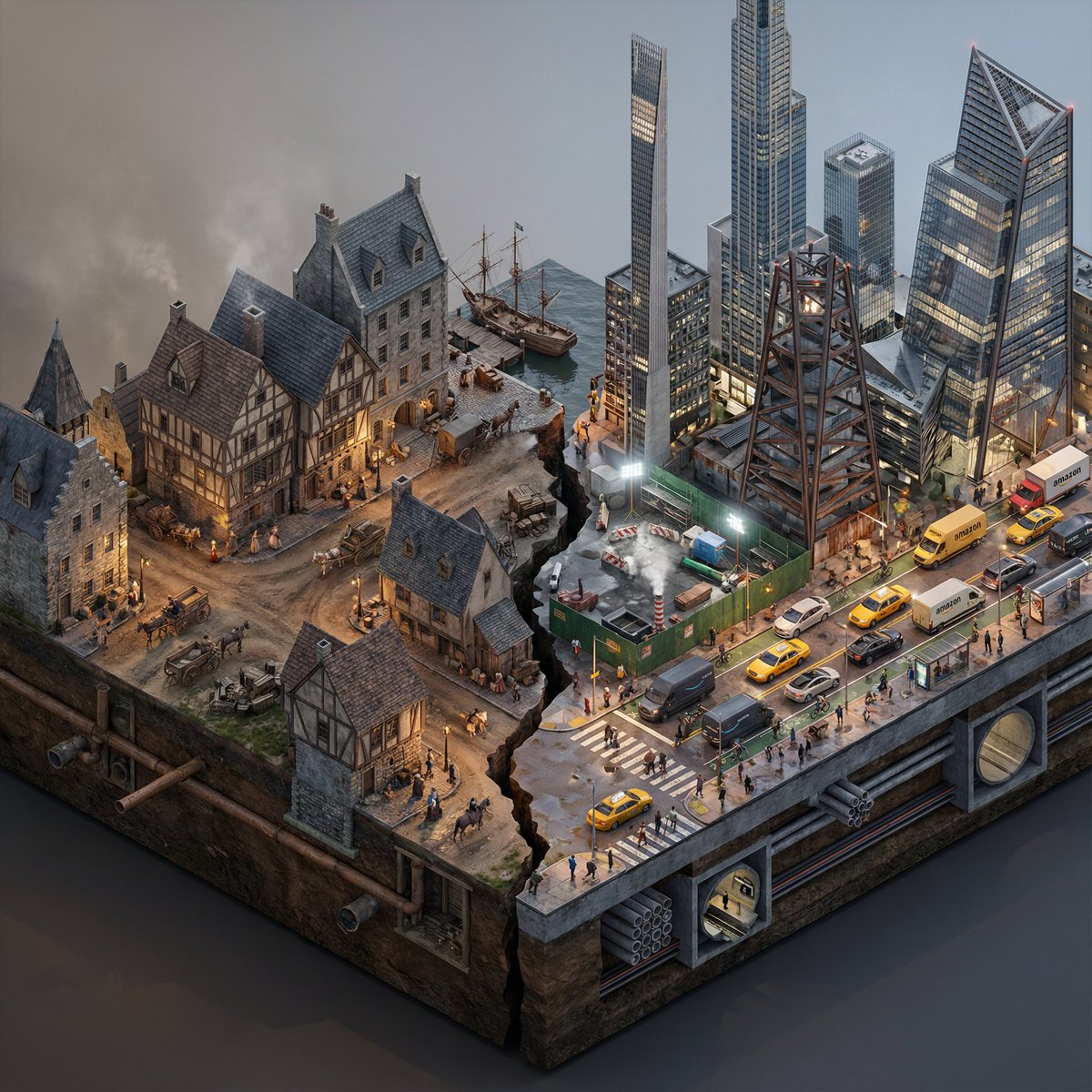
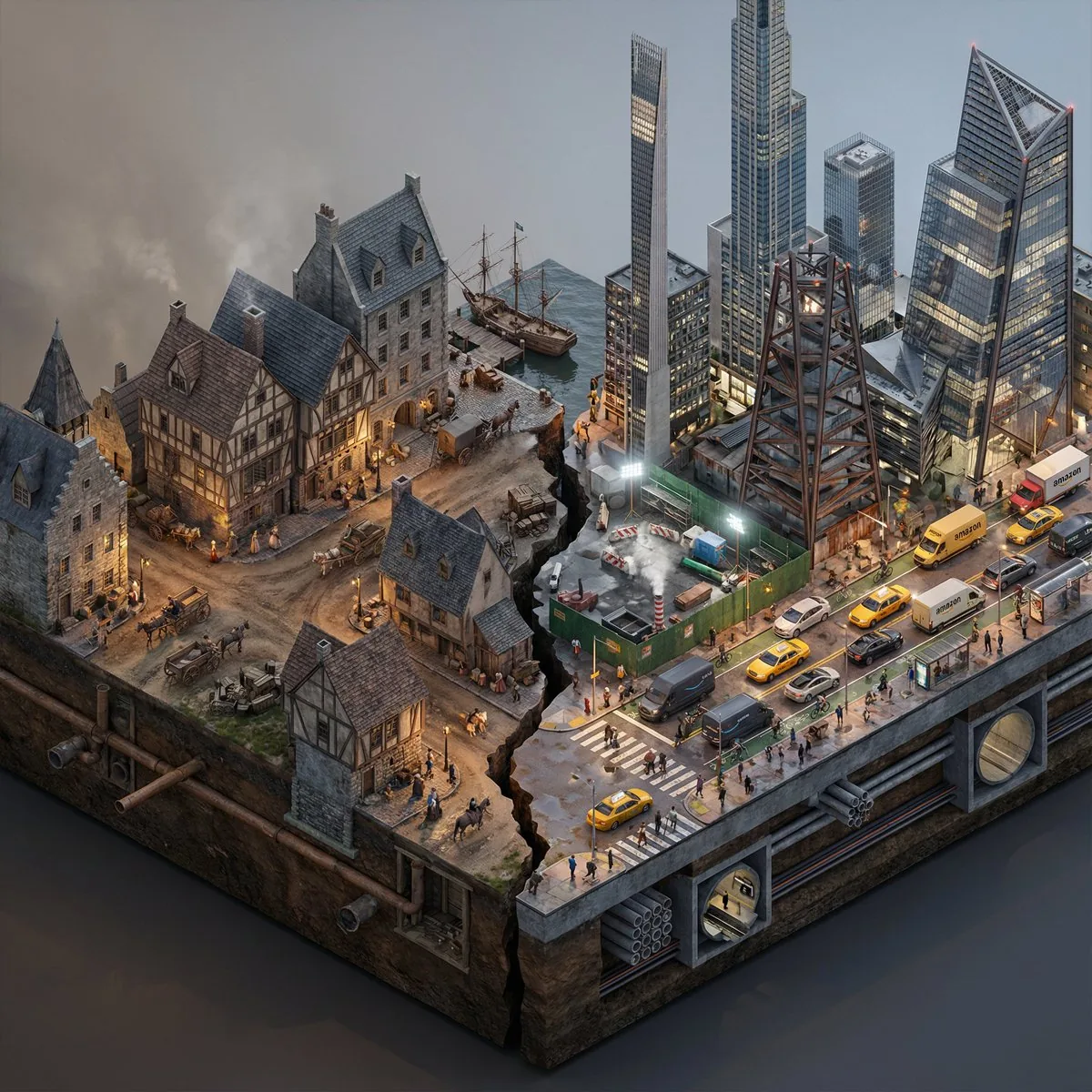
This is a highly detailed, multi-section system instruction designed for the Nano Banana Pro model to generate a photorealistic, isometric macro render of a split-era urban diorama. The prompt focuses on achieving Historical and Municipal Accuracy by contrasting two different time periods within the same city block, specifically detailing architectural styles, urban clutter, lighting, and composition for a realistic comparison.
Prompt
Do this for {argument name="City/Year A vs. City/Year B" default="New York 1700 vs New York 2025"}

<instructions>
Input Variable: [City/Year A vs. City/Year B] (e.g., New York 1900 vs. New York 2025)

System Instruction:
Generate a photorealistic, isometric macro render of a split-era urban diorama. The goal is Historical and Municipal Accuracy, avoiding sci-fi tropes or idealization.

1. Temporal Forensic Analysis:
Analyze the Dates:
 Strictly adhere to the architectural technologies available in Year A versus Year B.
The Left Block (The Past): Construct the Left side using the dominant vernacular of the era.
For 1900: Beaux-Arts stone, brick tenements, water towers, external fire escapes, and cobblestone/early asphalt.
The Right Block (The Present/Future): Construct the Right side using current urban realities, not futuristic fantasies.
For 2025: Prioritize "Super-Slender" Pencil Towers (Billionaire's Row style), Glass Curtain Walls mixed with preserved older facades, and "Hudson Yards" style angled steel.
  Crucial Detail: If the year is modern (2020+), you MUST include Urban Clutter: Green construction plywood barriers, sidewalk scaffolding (sheds), steam vents, and delivery trucks.

2. The Container (The Cross-Section):
The Base: Two suspended chunks of city infrastructure, revealing the "Underground" layer on the side profile.
Left Underground: Brick sewers and early subway tunnels.
Right Underground: Concrete conduit banks, fiber optic lines, and modern subway tiles.
The Divider: A jagged timeline fracture. No glowing sci-fi energy. The divide is a stark cut in the asphalt.

3. The Composition (The Density):
Left Street Life: Period-accurate transport (Horse-drawn carriages mixed with early Model T Fords or Trolleys). Pedestrians in dark coats/hats.
Right Street Life: Municipal Realism. Yellow Taxis, Amazon delivery vans, Uber cars, and bike lanes with cyclists. The street level should feel congested and chaotic.
Vegetation: Left has Elm trees (if applicable); Right has manicured "Corporate Plaza" planters and rooftop gardens.

4. Accurate Lighting Simulation (No "Neon Filters"):
Left Lighting: Carbon-Arc and Gaslight. The light should be dim, patchy, and warm (2400K), casting long shadows.
 Right Lighting: Mixed Municipal Lighting. A chaotic mix of warm sodium streetlights (orange), harsh white LED construction lights (6000K), and internal office lighting (neutral). Do not use "Cyberpunk Blue" or "Purple" unless it is a specific billboard.
Atmosphere: The Left is hazy from coal smoke. The Right has a clearer, sharper air quality but with light pollution.

5. Visual Syntax:
Camera: Isometric Orthographic projection, 45-degree angle.
Render Style: Photorealistic Architectural Visualization (ArchViz), 8k, V-Ray Render. Focus on texture fidelity (rust, wet pavement, grime) rather than bloom effects.

Output: 1:1 Aspect Ratio, Extreme Detail, Historically Authentic.Prompt breakdown
- Subject
- Split New York 1700 vs 2025 urban blocks showing colonial wooden buildings and dirt paths on the left against pencil towers, glass facades, and street clutter on the right, plus underground brick sewers versus fiber conduits
- Style
- Photorealistic isometric ArchViz render with 45-degree orthographic projection and extreme texture fidelity on materials like rust, grime, and pavement
- Lighting
- Dim warm gaslight and carbon-arc on the left at 2400K versus mixed sodium orange, 6000K LED construction lights, and neutral office lighting on the right
- Composition
- Two suspended infrastructure chunks divided by a jagged asphalt timeline cut, with period-accurate street life, vegetation, and side-profile underground cross-sections
Remix ideas
- Change the variable to Boston 1775 vs Boston 2025 to feature different colonial materials and Federal-style buildings
- Increase modern-side density by adding more bike-lane cyclists and steam vents while keeping the fracture line matte
- Shift underground focus deeper on the right to expose additional concrete conduit banks and modern subway tile patterns
Reference images
How to use this AI Image prompt template
 1
1Copy the prompt — grab this template’s prompt and negative prompt.  2
2Pick a model — choose a recommended AI model for the best match.  3
3Generate — open the studio with one click and create your result.
Related templates
Two-Story Japanese House Floor Plan
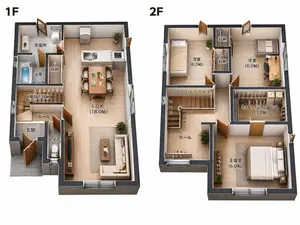
{"type":"clean 3D isometric residential floor plan rendering","scene":"two separate cutaway floor plans of a compact two-story Japanese house on a plain white background, presented side by side like a real-estate layout diagram","style":"high-resolution architectural visualization, realistic miniature model, orthographic/isometric top-down view, cutaway exterior walls with dark charcoal thickness, light wood flooring, warm natural lighting, crisp shadows, furniture and fixtures included, readable Japanese room labels in black","layout":{"section_count":2,"sections":[{"title":"1F","position":"left","description":"first-floor plan with entrance, bathroom area, storage, stair hall, toilet, and open living dining kitchen","visible_labels_count":7,"visible_labels":["洗面所","浴室","収納","階段下収納","ホール","玄関","トイレ","L.D.K (18.0帖)"],"rooms_and_features":"gray tiled genkan entrance at lower left, small toilet room beside entrance, hall and stairs with numbered stair markings, bath with blue water tub, washroom with sink and laundry machine, narrow storage closet, large open LDK occupying the right side with white kitchen island/counter, dining table for four, sofa, coffee table, TV console, plants, sliding glass openings"},{"title":"2F","position":"right","description":"second-floor plan with three bedrooms, two storage closets, walk-in closet, hall, and stairs","visible_labels_count":7,"visible_labels":["洋室 (6.0帖)","収納","収納","洋室 (6.0帖)","ウォークインクローゼット (3.0帖)","ホール","主寝室 (6.0帖)"],"rooms_and_features":"upper left bedroom with single bed, upper middle two vertical storage closets, upper right bedroom with desk and chair, central stair void with numbered steps and arrow, hall at lower left with plant and railing, large walk-in closet at mid-right with hanging clothes and shelves, lower right master bedroom with double bed, nightstands, plants, and wide window"}]},"text_requirements":"Use exact Japanese labels as shown, with bold large floor labels 1F and 2F above each plan. Keep all labels legible and placed inside their corresponding rooms.","customization":{"house type":"{argument name=\"house type\" default=\"compact two-story Japanese house\"}","floor label style":"{argument name=\"floor label style\" default=\"large bold black 1F and 2F labels\"}","flooring material":"{argument name=\"flooring material\" default=\"light natural wood flooring\"}","wall color":"{argument name=\"wall color\" default=\"white interior walls with dark charcoal exterior wall edges\"}","background":"{argument name=\"background\" default=\"plain white background\"}"},"camera":"top-down isometric orthographic architectural view, both floors fully visible with no perspective distortion","quality":"sharp, professional real-estate brochure quality, realistic scale, neat composition, no people, no watermark"}
Civilization-Style Tokyo Bay Screenshot
A highly detailed grand-strategy game screenshot in the visual style of a modern Civilization-like city view, showing an isometric aerial perspective of a dense coastal Japanese metropolis built on a compact island surrounded by deep blue ocean. The city should feel like late-20th-century Tokyo Bay, with a believable mix of real-world-inspired landmarks and stylized strategy-game worldbuilding. In the center, place a red-orange steel broadcast tower resembling Tokyo Tower, surrounded by several traditional temple and pagoda complexes with green-tiled roofs, embedded seamlessly inside a forest of tightly packed mid-rise and high-rise concrete and glass buildings. Include exactly 1 red lattice tower, exactly 3 prominent traditional temple or shrine complexes, exactly 2 multi-tier pagodas, exactly 1 large waterside stadium near the upper center shoreline, and exactly 1 monumental statue on a headland at the left edge of the island. The urban fabric should be extremely dense, with narrow streets, elevated roads, billboards, rooftop details, cherry blossom trees scattered through districts, commercial signage, docks, piers, warehouses, and mixed residential and office blocks. The shoreline must be irregular and heavily developed with harbors and ferry terminals, and the surrounding water should contain exactly 12 visible vessels of mixed types: ferries, small motorboats, workboats, yachts, and 1 tall-masted sailing ship near the lower right. Render the water in rich teal-to-navy gradients with shallow coastal transparency and detailed wakes. Present it explicitly as a video game interface screenshot. Add a thin top status bar with resource counters and turn information; the upper right should read Turn: 103, 1992 CE, 2:51 PM. Place exactly 7 leader banners across the upper right, each with a different color and emblem, and include a diplomacy panel naming Tokugawa Ieyasu (leader name) of the Japanese Empire (civilization name). On the left side, add a vertical journal panel titled Journal with 3 quest entries and small circular icons. In the lower left, include exactly 1 minimap framed in ornate UI styling. In the lower right, include a large circular command interface with metallic bronze-and-gold ornamentation and a button labeled GROW TOWN (button text); around it place exactly 3 smaller circular action buttons. The overall interface should feel premium, intricate, and historically flavored rather than futuristic. The city itself should evoke Tokyo, Japan (location) in 1992 CE (era), recreated as a lush, polished, slightly idealized 4X strategy game screenshot with cinematic lighting, crisp miniature-like detail, realistic urban density, authentic Japanese transportation and waterfront infrastructure, and a color palette of ocean blue, concrete gray, greenery, copper UI metals, and pops of neon signage. Use a high-angle three-quarter camera, sharp focus across the whole city, and richly textured, painterly-realistic rendering consistent with gpt-image-2 game concept screenshot output.
Cinematic Atlas Miniature World Diorama
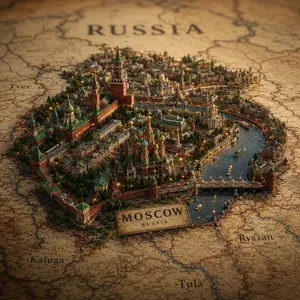
An ultra-premium cinematic atlas visualization of COUNTRY (country) designed as a luxurious collectible miniature world built directly into an aged textured world map. Instead of a simple diorama, the scene features an elevated hyper-detailed micro-city of CITY (city) emerging organically from the terrain like a living architectural island. The environment contains iconic monuments, historic buildings, rivers, bridges, tiny streets filled with realistic urban depth, glowing windows, vegetation, atmospheric details, and elegant cultural symbolism crafted with museum-level precision. The camera angle feels like a high-end macro documentary photograph captured with a professional tilt-shift lens, creating an immersive miniature illusion with cinematic depth separation. Surrounding map typography, borders, coordinates, and neighboring regions remain subtly visible beneath the structure, blending cartography with luxury worldbuilding. Add dramatic golden-hour sunlight mixed with soft volumetric atmospheric haze, realistic ambient occlusion, global illumination, rich shadows, ultra-detailed textures, reflective water canals, tiny moving boats, miniature street lamps, cinematic fog layering, and refined environmental storytelling. Include subtle weathered paper textures, embossed map details, and elegant depth transitions for a premium handcrafted aesthetic. The color grading should feel inspired by luxury travel documentaries and next-generation editorial campaigns — warm golden highlights, rich earthy greens, elegant ivory paper tones, deep architectural contrast, and subtle teal shadows. The composition must feel grand, immersive, artistic, and visually unforgettable. Ultra-photorealistic, insanely detailed, masterpiece-quality, hyper-realistic materials, advanced global illumination, macro realism, depth-rich cinematic atmosphere, luxury travel aesthetic, collectible miniature world design, editorial-quality rendering, 8K ultra detail.3c

Historical Era Bedroom Interior Map
Create a creative image of Historical Era Bedroom Interior Map. Style: photorealistic. Composition: balanced and well-framed. Lighting: natural with cinematic mood. Category: photography. Reference: historical-era-bedroom-interior-map-18763.
Testing Strict Prompt Adherence in GPT Image 1.5 vs. Gemini
Create a creative image of Testing Strict Prompt Adherence In Gpt Image 15 Vs Gemini. Style: photorealistic. Composition: balanced and well-framed. Lighting: natural with cinematic mood. Category: photography. Reference: testing-strict-prompt-adherence-in-gpt-image-15-vs-gemini-2364.

Isometric Exploded Urban Asset Sheet
A massive isometric exploded-view environment sheet showing a dense collection of modular retro urban buildings and room cutaways on a clean white background, rendered like a highly detailed game asset breakdown or architectural kitbash catalog. The image contains 20 main assembled structures or room modules, each separated into floating parts: 1 small gabled house with blue roof, 1 dark blue square building, 1 small rust-red house, 1 cylindrical weathered tower building, 1 white two-story house with blue roofs, 1 warm wood-paneled corner room, 1 compact study or office room, 1 bedroom, 1 dining room with balcony, 1 café or kitchen room, 1 narrow storefront room, 1 small lit alcove room, 1 large concrete stairwell block, 1 small tiled washroom, 1 medium concrete stair-and-landing block, 1 larger concrete stair platform block, 1 narrow concrete corridor or service block, 1 large empty concrete room, and 1 blue vending machine pair area. Surrounding all modules are hundreds of separated components arranged neatly in exploded fashion: roof panels, corrugated awnings, wall segments, doors, shutters, windows, stair flights, railings, balconies, signboards, pipes, antennas, utility poles, lamps, vents, meters, tanks, planters, flower boxes, benches, crates, air conditioners, cabinets, fences, street barriers, buckets, jars, utility boxes, and small street props. The style is painterly but precise, with cozy amber interior lighting contrasting against worn concrete, oxidized metal, chipped paint, rust-red and deep blue roofs, teal-green trim, and aged urban textures. Emphasize miniature diorama realism, isometric perspective, exploded assembly presentation, many floating parts evenly spaced around each structure, highly legible silhouette separation, soft studio shadowing, extremely intricate detail, concept-art polish, and the feeling of a comprehensive environment asset sheet for a side-street neighborhood in a nostalgic Japanese retro urban district (city style). Include exactly 20 major modules, with the lower edge lined by many small props and potted plants, and keep the overall composition balanced across the full canvas. Use a crisp white background, no framing, no people, no vehicles except 1 bicycle, and no text labels.3
Explore more prompts
Browse more AI image and video prompts by category.
FAQ
- How does the prompt handle the 1700 left side to stay historically accurate?
- It limits construction to wooden colonial buildings, dirt paths, basic brick sewers, and period transport like horse-drawn carriages without later inventions.
- What specific urban clutter appears on the 2025 right side?
- Green construction plywood barriers, sidewalk scaffolding sheds, steam vents, yellow taxis, Amazon delivery vans, and Uber cars create realistic congestion.
- Is the Split-Era Urban Diorama Generation Prompt for Nano Banana Pro - Nano Banana Pro AI Prompt for Infographic / Edu Visual prompt free to use?
- Yes, this prompt is completely free on AI Pin Maker and you can copy it directly with no signup or payment required.
- How do I use the Split-Era Urban Diorama Generation Prompt for Nano Banana Pro - Nano Banana Pro AI Prompt for Infographic / Edu Visual prompt to generate an image or video?
- Copy the prompt, tweak the subject or style to fit your idea, then paste it into AI Pin Maker and generate your image or video in one click.
- Can I change the Split-Era Urban Diorama Generation Prompt for Nano Banana Pro - Nano Banana Pro AI Prompt for Infographic / Edu Visual prompt into my own version?
- Absolutely, just replace the subject, style, or parameters in AI Pin Maker to make the prompt entirely your own.