
Text to Image
Crystal Golem Card Comparison UI — AI Image Prompt
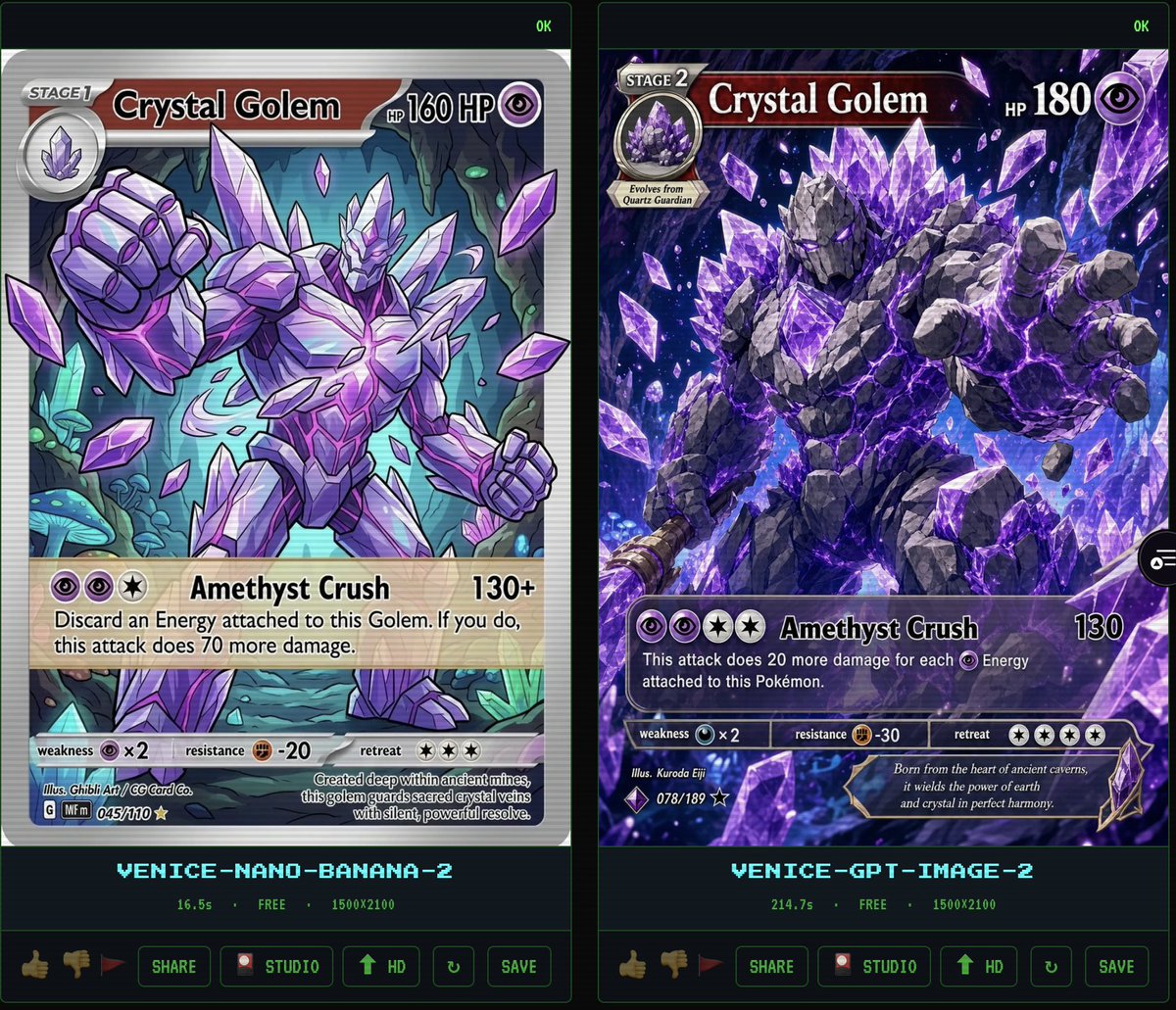
Generates a side-by-side benchmark-style screenshot comparing two fantasy Crystal Golem trading card designs in a dark neon UI.
Prompt
Goal: Create a dark comparison screenshot showing two fantasy trading-card designs side by side, as if from an image generation benchmark UI.

Canvas: Landscape 16:9 composition, black/dark charcoal background with thin neon-green outlines. Two tall vertical panels fill the frame, left and right, separated by a narrow gap. Each panel contains one collectible monster card preview above a small status/control area.

Layout: Use exactly 2 main panels. The left panel is labeled at the bottom in cyan pixel text “VENICE-NANO-BANANA-2”; the right panel is labeled “VENICE-GPT-IMAGE-2”. Each panel has a tiny green “OK” indicator in its top-right corner. Under each label, show a small metadata row with time, “FREE”, and “1500x2100”. At the very bottom of each panel, include a row of small UI buttons/icons: thumbs up, thumbs down, red flag, “SHARE”, “STUDIO”, “HD” with an up-arrow, a refresh icon, and “SAVE”.

Subject: Both cards depict the same Pokémon-inspired character, {argument name="character name" default="Crystal Golem"}, a massive humanoid golem made of jagged gray stone and glowing purple amethyst crystals, with violet energy cracks, crystal spikes, clenched fists, and floating crystal shards. The card type uses a purple psychic/eye symbol. Make the cards look like polished fantasy trading cards, but not an exact copy of any real copyrighted card template.

Left card details: A Stage 1 card with a silver-gray border and slightly older illustrated-card look. Header text reads “STAGE 1”, {argument name="card title" default="Crystal Golem"}, and “HP 160 HP”. Include a small circular evolution portrait at top left. The artwork shows the golem from the waist up inside an underground crystal cavern with teal mushrooms and glowing green cave lights, one fist raised toward the viewer, many purple crystal shards floating around. Use clean anime/comic line art, pale lavender highlights, and a holographic sheen. Attack area contains exactly 1 attack: “Amethyst Crush” with damage “130+”. Attack text: “Discard an Energy attached to this Golem. If you do, this attack does 70 more damage.” Bottom stats show weakness “×2”, resistance “-20”, and retreat with three star/colorless symbols. Include tiny illustrator/collector text and a short flavor line near the bottom.

Right card details: A Stage 2 card with a darker, more cinematic high-detail look and a black/purple border. Header text reads “STAGE 2”, {argument name="card title" default="Crystal Golem"}, and “HP 180”. Include a small evolution box at upper left reading “Evolves from Quartz Guardian”. The artwork fills more of the card and shows the golem lunging forward through an explosive cavern of purple crystals, with one huge open hand reaching toward the viewer, intense glowing violet eyes, black rock texture, luminous amethyst veins, and many floating crystal shards. Attack area contains exactly 1 attack: “Amethyst Crush” with damage “130”. Attack text: “This attack does 20 more damage for each Energy attached to this Pokémon.” Bottom stats show weakness “×2”, resistance “-30”, and retreat with four star/colorless symbols. Add tiny illustrator/collector text and a flavor quote: “Born from the heart of ancient caverns, it wields the power of earth and crystal in perfect harmony.”

Visual style: High-contrast digital art, glossy trading-card foil effects, purple crystal magic, dark cave backgrounds, sharp details, cyan pixel UI labels, neon green UI outlines. The left card should appear cleaner and more cartoon/anime, while the right card should appear more dramatic, dense, and rendered.

Constraints: Include exactly 2 card panels and exactly 1 trading card in each panel. Include exactly 1 attack on each card. Preserve all visible English labels named above. Do not add extra cards, characters, logos, watermarks, or real brand names.38:Tf6a,Goal: Create a dark comparison screenshot showing two fantasy trading-card designs side by side,Prompt breakdown
- Subject
- Pokémon-inspired Crystal Golem with clenched fists, floating crystal shards, and amethyst spikes on both cards
- Style
- Left Stage 1 uses silver-gray border and clean anime/comic line art with holographic sheen; right Stage 2 uses black/purple border and dense cinematic rendering
- Lighting
- Violet energy cracks plus teal mushrooms with green cave lights on left, explosive purple crystal glow and luminous amethyst veins on right
- Composition
- Landscape 16:9 split into two tall vertical panels with neon-green outlines on dark charcoal background, each containing one card above metadata and button row
- Mood
- Dark comparison atmosphere highlighting model differences in fantasy card polish and drama
Remix ideas
- Replace the left cavern background with molten lava fissures to test environmental contrast
- Increase right card HP to 200 and adjust retreat cost to five symbols for balance experiments
- Swap attack text on both cards to reference discarding two Energy instead of one
Reference images
How to use this AI Image prompt template
 1
1Copy the prompt — grab this template’s prompt and negative prompt.  2
2Pick a model — choose a recommended AI model for the best match.  3
3Generate — open the studio with one click and create your result.
Related templates

Vertical Pixel Space Shooter Background
Create a vertical retro pixel-art space shooter scrolling background, designed as a seamless mobile game asset. The canvas is a tall 9:16 portrait frame with a dark central flight corridor left mostly open for gameplay. Fill the scene with a deep black starfield, hundreds of tiny white, blue, and violet pixel stars, and two luminous vertical nebula streams: one winding down the left side in electric purple and blue, and one winding down the right side in purple with cyan highlights. Add exactly 3 visible planets: a large purple cratered planet near the upper left edge, a large blue-purple rim-lit planet partially cropped on the lower right edge, and a small purple moon just below that lower-right planet. Add exactly 22 rocky asteroids of varied sizes, irregular cratered gray-brown forms with purple shadowing, distributed around the border while keeping the center mostly clear: 1 huge asteroid near the upper right, 1 medium asteroid at the right-middle edge, 1 medium asteroid at the lower left edge, 1 large asteroid cropped at the bottom left corner, 1 large asteroid cropped at the lower right corner, plus 17 smaller asteroids scattered near the top edge, side edges, and lower border. Use crisp pixel-art rendering with high-detail dithering, chunky jagged silhouettes, bright rim highlights, no outlines that look vector-smooth, no ships, no UI, no text, no watermark. Color palette: black space, violet and magenta nebula clouds, electric blue accents, white star glints, gray rocky asteroids with cool purple shadows. The image should feel production-ready as a vertical shoot ’em up background tile, dramatic but readable, with the gameplay lane clear in the center.39

PC-98 Gothic Visual Novel UI
{"type":"PC-98 style retro Japanese adventure game screenshot","style":"late 1980s to early 1990s Japanese visual novel interface, 640x480, 4:3 aspect ratio, black background with limited neon green and pale pink dithering, high-contrast 1-bit and 16-color pixel art, ornate gothic frame, CRT-like pixel texture","scene":{"setting":"dark Victorian gothic bedroom or parlor at night","background":"symmetrical room with tall arched windows glowing green, heavy draped curtains, candle sconces on both sides, antique table and chair on the left, ornate sofa on the right, carved furniture, floral and vine decorations, deep shadows","palette":"mostly black and acid green linework with small white and pink highlights"},"character":{"position":"center foreground bust-up, facing viewer","description":"androgynous anime rabbit-eared character with long upright bunny ears, fluffy layered hair, pale lavender-white hair with lime green shadows, dressed in a black gothic lolita-inspired blouse and fitted vest with ruffles, puff sleeves, ribbon bow at the collar, green jewel brooch, belted waist with three small buckles, hands resting near the lower frame","face":"covered by a square pixelated mosaic censor block over the central face area","hair color":"{argument name=\"hair color\" default=\"pale lavender-white with lime green shadows\"}","outfit color":"{argument name=\"outfit color\" default=\"black gothic formalwear\"}"},"layout":{"main image panel":{"position":"upper left and center","description":"large framed illustration window containing the character and room"},"command menu":{"position":"right side vertical panel","title":"COMMAND","count":8,"labels":["TALK","LOOK","MOVE","USE","ITEM","LOAD","SAVE","SYSTEM"],"highlight":"TALK is selected with a rectangular outline"},"dialogue box":{"position":"bottom left","description":"large black text box with ornate green corners and a small green triangular continue marker at lower right","text":"{argument name=\"dialogue text\" default=\"はぁ♡ 今日も推しカプが尊い♡\"}"},"logo panel":{"position":"bottom right","description":"decorative title logo with bat wings, roses, swirls, and a heart emblem","text":"{argument name=\"game title\" default=\"今日のミナレイズ\"}"}},"ornaments":"thin neon-green botanical border around the whole interface with roses, vines, curls, bats, and lace-like corner details","rendering instructions":"make the UI atmosphere extremely authentic to a PC-98 adventure game: sharp low-resolution pixels, dithering patterns, minimal animation-frame composition, Japanese game screenshot feeling, no modern gradients, no photorealism"}
Retro Pixel Space Shooter Sprites
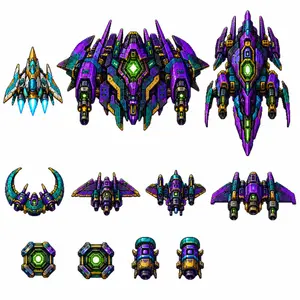
Create a clean sprite-sheet style asset image for a vertical retro pixel-art space shooter, on a plain white background with no grid and no labels. Show exactly 11 separate pixel-art spaceship and power-up sprites arranged in three rows, all with crisp black outlines, high-contrast shading, metallic panels, tiny vents, glowing cores, and 16-bit arcade detailing. Use a saturated sci-fi palette dominated by deep violet purple (main ship color), teal/cyan, dark navy, black, gold/orange armor accents, and neon green energy lights. Layout: top row contains exactly 3 large player/enemy ships: left is a small blue-white-and-gold triangular fighter with three bright cyan engine flames; center is the largest wide boss ship, symmetrical and heavily armored, purple and teal with multiple wing spikes, twin side cannons, gold trim, and a large glowing green hexagonal reactor in the middle; right is a tall vertical purple capital ship with pointed nose, side fins, teal panels, gold details, and a glowing green central reactor. Middle row contains exactly 4 medium enemy ships: a crescent-shaped teal and purple craft with two upward curved horns and a green cockpit glow; a compact rear-view purple winged fighter with side thrusters; a squat central gunship with teal cockpit dome, purple wings, gold barrels, and twin cannons; a broad purple bomber with swept wings, side engine pods, and a large dark central intake. Bottom row contains exactly 4 small collectible or module sprites: two square neon-green reactor power-up tiles with beveled purple/teal/gold frames, followed by two identical small cylindrical engine or booster pods with teal top caps, purple bodies, gold front panels, black exhausts, and tiny side fins. Style constraints: production-ready pixel art, orthographic/top-down view, transparent-asset feel but rendered on white, sharp square pixels, no anti-aliased painterly look, no text, no watermark, no shadows beyond pixel-art contact shading, consistent scale hierarchy and spacing, like a polished mobile shoot’em-up tileset.38
Cute Pixel Art Sandbank Robot Team
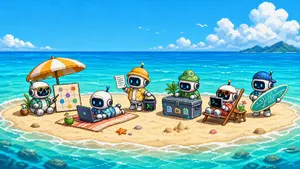
Create a cute wide pixel-art promotional illustration for Sandbank Agent (project name), showing a tiny tropical sandbank island in the middle of bright turquoise ocean under a sunny blue sky. Canvas: 16:9 landscape, retro 16-bit pixel art, crisp blocky pixels, high saturation, charming game-art aesthetic, no text overlays or watermark. Scene: a small oval sandy island surrounded by shallow aqua water, white surf rings, coral and rocks visible below the water, distant green island on the far right horizon, huge puffy pixel clouds, tiny white birds, sparkling sea highlights. Main subjects: exactly 6 adorable chibi robots with rounded white bodies, black glass screen faces, cyan glowing eyes, small antennas, and beach/workspace accessories, arranged left to right across the sand. Robot 1 sits under a large orange-and-white beach umbrella wearing sunglasses and a turquoise Hawaiian shirt, next to a coconut drink and a standing planning board showing connected colored nodes. Robot 2 lies on a striped beach towel using an open laptop, wearing blue tropical swim shorts, with a coconut drink beside the towel. Robot 3 stands in the center wearing a yellow-orange explorer jacket and yellow hardhat, holding a clipboard in one hand and a small black terminal cube with a green command prompt symbol in the other. Robot 4 sits behind a large dark equipment chest, wearing a green bucket hat and green outfit; the chest has three colorful file/app icons on the front. Robot 5 lounges in a wooden beach chair wearing orange sunglasses and red swimwear, using a black laptop with a green command prompt symbol; a small side table holds a green drink and a vertical board or paddle rests behind the chair. Robot 6 stands at the far right wearing a blue cap and holding a turquoise surfboard decorated with circuit-board lines, suggesting playful developer infrastructure. Add small beach details: exactly 1 orange starfish near the center foreground, several small shells and pebbles, a small sandcastle mound near the equipment chest, and soft shadows under every object. Mood: cheerful, cute, collaborative, techy beach-vacation workspace harness vibe. Use cyan (robot face glow color) screen glows, bright turquoise (ocean color) water, orange and white (umbrella color), and 16-bit retro game art (pixel art style). Keep all elements clearly readable at small size, with clean silhouettes and balanced spacing.
Technical Blueprint of an AI GPU Cluster - Nano Banana Pro AI Prompt for Infographic / Edu Visual
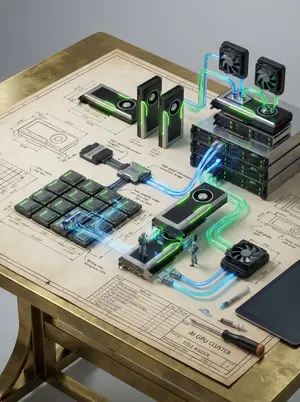
A detailed technical blueprint of a high-performance AI GPU cluster placed on a polished brass drafting table, with a photorealistic miniature AI server system self-assembling from it — multiple GPU accelerator units (sleek black and metallic modules with neon green accents) rising from the dimension lines, high-speed interconnect bridges threading through the tolerance annotations, and dense compute nodes forming from the grid layout. Stacks of GPU cards slide into server chassis above the parts list, each unit locking in with precision. NVLink-style connectors and high-bandwidth interconnects assemble seamlessly between GPUs, forming a powerful parallel compute network. Rack-mounted AI servers emerge vertically, with layered compute blades building upward in perfect alignment. A liquid cooling system forms from exploded-diagram callouts — transparent cooling pipes with glowing coolant flowing through them, cold plates attaching to GPUs, and radiators assembling with high-performance fans. Heat dissipation fins and airflow channels dynamically shape around the system. A tiny engineer in futuristic protective gear stands on a GPU module inspecting circuits with a holographic diagnostic interface, while another miniature technician connects high-speed data cables into a switch unit. Fiber optic lines glow faintly, representing active data transfer. Functional details illuminate — GPU core lights pulsing softly, status LEDs blinking in synchronized patterns, data streams visualized as glowing lines moving between nodes, and monitoring panels activating during assembly. Signature tools of the trade — precision screwdriver, thermal paste applicator, anti-static tools, fiber connectors, and a digital diagnostic tablet — rest across the blueprint’s title block, partially integrated into the scene. All elements grow organically from the blueprint like a 3D mechanical diorama — circuit traces rising from printed schematics, GPU modules emerging from drawn outlines, cables threading through pencil grid lines. Seamless transformation from 2D blueprint into a fully operational AI infrastructure. LIGHTING: Soft studio lighting combined with strong neon green and cool blue glows from GPUs and data pathways. Subtle reflections from the brass surface and volumetric light enhancing depth. CAMERA & LENS: Shot on a full-frame camera, 35mm lens. Slight low-angle perspective to emphasize scale and power. Cinematic depth of field with focus on central GPU cluster. COMPOSITION: Vertical 2:3 format. Central stacked GPU cluster rising upward with symmetrical balance. Clean negative space around edges with layered depth. STYLE & MOOD: Futuristic, cinematic, high-end AI infrastructure aesthetic inspired by NVIDIA design language. Powerful, clean, and cutting-edge. DETAILS: Ultra-detailed textures — matte black metal, glowing accents, micro circuitry, cooling liquid reflections, cable braiding, LED indicators. 8K resolution, HDR,3f:Tba7,A detail
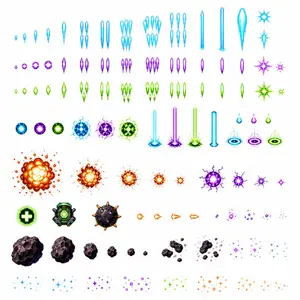
Retro Space Shooter VFX Sprite Sheet
Goal: Create a clean white-background production asset sheet for a vertical retro pixel-art space shooter, showing separate glowing projectile, explosion, pickup, asteroid, and particle-effect sprites in a consistent 2D pixel-art style. Canvas: Square 1:1 sprite sheet, about 768×768 px, pure white background, no grid, no labels, no borders, sprites evenly spaced in horizontal rows with transparent-looking whitespace around each asset. Visual style: High-resolution retro pixel art with crisp edges, neon glow, saturated colors, arcade shoot’em-up VFX, black or dark outlines only where needed, additive bloom-like halos, no text. Color palette: Use three main energy colors: electric cyan (cyan energy color), magenta violet (purple energy color), and lime green (green energy color), plus orange/yellow fire for explosions and gray-brown rocks for asteroids. Layout and exact asset count: Arrange exactly 103 visible sprites in 8 rows. Row 1: 17 cyan player-shot sprites, including tiny bullets, small teardrop shots, medium diamonds, paired vertical bolts, triple clusters, grouped shard volleys, three narrow exclamation-like bolts, two long laser beams, one large missile-like glowing spear, and two cyan starburst impact flashes. Row 2: 16 purple enemy-shot sprites, including small round bullets, larger orbs, a thin diamond bolt, paired bolts, triple grouped bolts, clustered shards, three vertical capsules, three single vertical bolts, and two purple starburst impacts. Row 3: 16 green enemy-shot sprites matching the purple row types: small diamonds, larger diamonds, a bright spear bolt, paired bolts, triple grouped bolts, clustered shards, three capsules, three single vertical bolts, and two green starburst impacts. Row 4: 15 special energy sprites: three circular neon orbs in cyan, purple, and green; three larger cracked plasma orbs in cyan, purple, and green; three vertical ground-strike laser columns in cyan, purple, and green with splashing bases; one solid cyan vertical beam; and three droplet-over-ring portal effects in cyan, purple, and green. Row 5: 9 explosion and impact sprites: five orange fire explosions decreasing from very large to tiny, followed by four purple electric impact bursts decreasing from medium to tiny plus a small diamond sparkle at the end. Row 6: 10 gameplay objects and small shots: one green health pickup icon with a white plus sign, one green mechanical power-up module, one dark spiked mine, four orange arrow/fireball projectile frames facing right, and three purple homing/particle projectile clusters. Row 7: 10 asteroid/debris sprites: six rocky asteroids decreasing from large to pebble size, followed by four broken debris clusters of scattered rock fragments. Row 8: 10 particle sparkle clusters: two cyan sparkle clusters, two purple sparkle clusters, two green sparkle clusters, two orange sparkle clusters, and two sparse orange trailing sparkle clusters. Subject details: Make the projectiles readable as individual game sprites, each centered in its own whitespace area. Energy bullets should be symmetrical, vertically oriented where appropriate, and glow softly. Explosions should use layered yellow cores, orange petals, red outlines, and scattered sparks. Asteroids should be irregular dark rock forms with pixel highlights and shadows. Pickups should be bolder and more icon-like than projectiles. Constraints: Generate only the sprite sheet assets, not a gameplay screenshot. No background scene, no UI, no characters, no ships, no typography, no watermark. Keep every asset isolated and production-ready for cutting into tiles or sprites.39:
Explore more prompts
Browse more AI image and video prompts by category.
FAQ
- What exact UI labels appear under each card panel?
- Cyan pixel text shows model names VENICE-NANO-BANANA-2 and VENICE-GPT-IMAGE-2 plus tiny rows with time, FREE, 1500x2100, and a full row of thumbs up, thumbs down, red flag, SHARE, STUDIO, HD, refresh, and SAVE icons.
- How does the artwork differ between the two Crystal Golem cards?
- Left Stage 1 shows waist-up pose with one fist raised amid teal mushrooms; right Stage 2 fills more space with the golem lunging, open hand reaching forward, and denser floating shards in an explosive crystal cavern.
- Is the Crystal Golem Card Comparison UI prompt free to use?
- Yes, this prompt is completely free on AI Pin Maker and you can copy it directly with no signup or payment required.
- How do I use the Crystal Golem Card Comparison UI prompt to generate an image or video?
- Copy the prompt, tweak the subject or style to fit your idea, then paste it into AI Pin Maker and generate your image or video in one click.
- Can I change the Crystal Golem Card Comparison UI prompt into my own version?
- Absolutely, just replace the subject, style, or parameters in AI Pin Maker to make the prompt entirely your own.