
Text to Image
Complex Four-Quadrant Paper World Composite Prompt — AI Image Prompt
A highly detailed and complex prompt designed to create a seamless 16:9 composite image divided into four distinct quadrants, each representing a different brand (Luckin, Google, Coke, McDonald's) using intricate paper-cut aesthetics and specific structural requirements, rendered in Octane. - AIPinMaker
Prompt
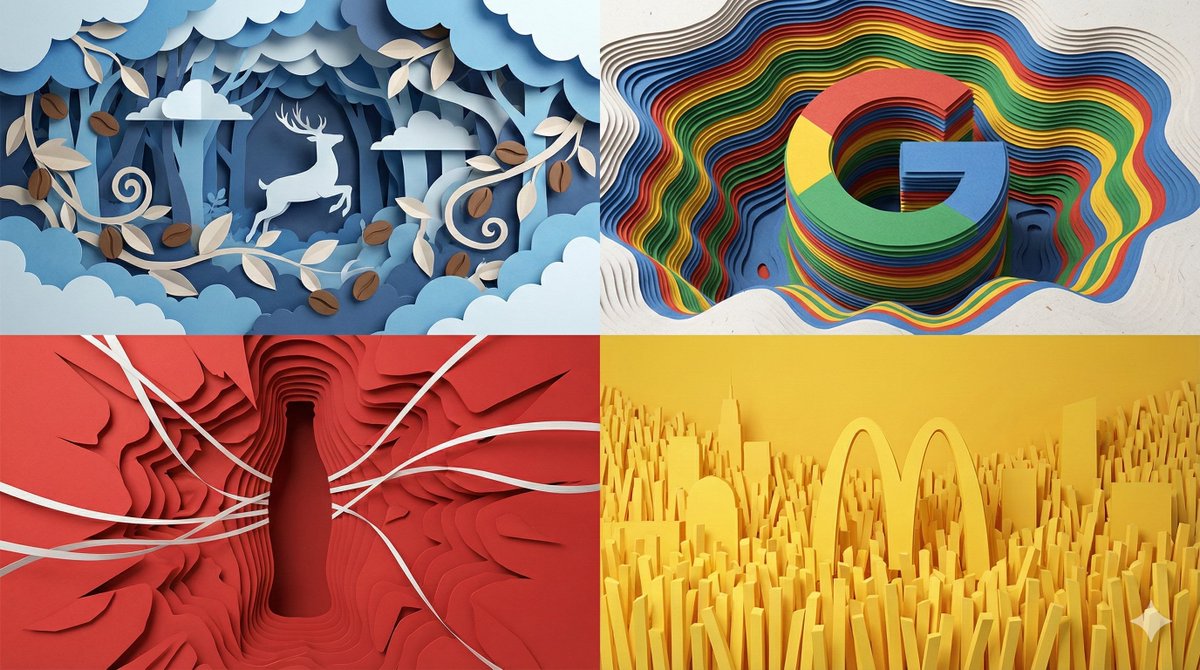
A seamless 16:9 full-frame composite image divided into four distinct quadrants. **CRITICAL:** The four sections touch each other directly. NO GREY BACKGROUND. NO BORDERS. NO GAPS. The image is filled edge-to-edge with paper details.

**Composition:** A split-screen view looking deep into four different paper worlds.

1) **Top-Left (Luckin):** A wide view of a magical paper forest. Blue and white paper clouds and coffee leaves fill the quadrant completely. A white paper stag leaps through the density.
2) **Top-Right (Google):** A wide view of a **"Topographic Map" style paper cavern**. The "G" logo is formed by **hundreds of thin sheets** of Blue, Red, Yellow, and Green paper stacked horizontally. It looks like a sediment canyon or a contour map. Visible paper fibers and sharp cut edges. NO plastic smoothness.
3) **Bottom-Left (Coke):** A wide view of a red paper explosion. The Coke bottle is a **Negative Space Silhouette**—a deep hole void cut through dense layers of red paper. White paper ribbons span across the void.
4) **Bottom-Right (McDonald's):** A wide view of a yellow paper city. Vertical strips of yellow paper (french fries) stand densely packing the frame. The Golden Arches rise from deep within the layers.

**Global Material:** Everything is matte cardstock.
**Lighting:** Soft, even studio lighting revealing the depth of the paper cuts.
**Tech:** Octane render, 8k, --ar 16:9 --stylize 400 --no borders, frames, background wall, isolated objects, 3d plastic, seamless texture3f
Prompt breakdown
- Subject
- Four brand-themed paper worlds: Luckin magical forest with blue-white clouds, coffee leaves and white stag; Google topographic map cavern with stacked multicolored sheets forming G logo; Coke red paper explosion with negative-space bottle silhouette and white ribbons; McDonald's yellow paper city of vertical fry strips and golden arches
- Style
- Matte cardstock with visible fibers, sharp cut edges, stacked horizontal sheets, negative space voids and dense vertical strips
- Lighting
- Soft even studio lighting revealing depth of paper cuts
- Composition
- Seamless 16:9 frame divided into four touching quadrants filling edge-to-edge with no borders, gaps or background
Remix ideas
- Replace the Luckin stag with a paper fox mid-leap among the coffee leaves
- Add extra red and yellow layers to the Google canyon to sharpen the G logo contours
- Increase the crisscross density of white ribbons spanning the Coke negative-space void
How to use this AI Image prompt template
 1
1Copy the prompt — grab this template’s prompt and negative prompt.  2
2Pick a model — choose a recommended AI model for the best match.  3
3Generate — open the studio with one click and create your result.
Related templates
Technical Isometric Teardown Infographic
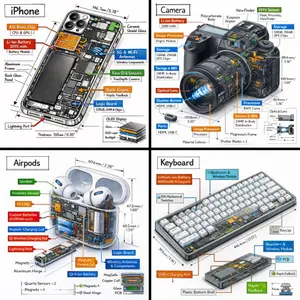
Generate a technical infographic of OBJECT (object) rendered from a 45-degree isometric 3D viewpoint (viewpoint), with the object slightly tilted to expose depth and three-dimensional structure. Blend a photorealistic render of the object with hand-drawn black ink technical annotations on a clean pure-white background. Include: - Color-coded callout boxes labeling each key component - Transparent / cutaway sections that reveal internal parts - Precise measurements, dimensions, and scale markers - Material descriptions and quantity counts - Color-coded directional arrows for function and flow: RED for power/battery, BLUE for data/connectivity, ORANGE for thermal/processor, GREEN for sensors/haptics - Simple schematics or cross-section diagrams where useful Place the "OBJECT (object)" title inside a hand-sketched technical frame in the top-left corner. Style: black architectural-pen linework, sketchy yet precise; the object remains fully visible; vibe of a professional engineering teardown or museum exhibit. Clean layout with balanced negative space. Perspective: 45-degree isometric tilt that dramatically reveals depth, dimension, and internal architecture, like a product engineering manual. Color usage: roughly 10-15% accent density, black dominant, white background. Output: 1080x1080, ultra-crisp, optimized for social feeds.
Exploded View Invention Infographic
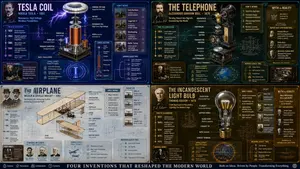
2x2 grid, do this for tesla coil (invention) and 3 other famous inventions. 16:9 inventor_content = ( patent_drawing_recreation_in_isometric_exploded_view_of_[invention (invention placeholder)]_by_[inventor (inventor placeholder)] * 1.7 ) + ( historical_context_timeline_of_scientific_breakthroughs_leading_to_[invention] * 1.5 ) + ( failure_log_and_iteration_cards_showing_[inventor]_s_failed_prototypes_with_annotations * 1.6 ) + ( cross_section_and_mechanics_diagram_of_[invention]_with_material_callouts * 1.4 ) + ( economic_and_cultural_impact_ripple_map_of_[invention]_on_society * 1.3 ) + ( quirky_personal_habit_or_workshop_inserts_from_[inventor]_s_biography * 1.2 ) + ( modern_day_derivative_technologies_tree_from_[invention] * 1.1 ) + ( common_misconception_busting_panel_about_who_really_invented_[invention] * 1.0 ) - ( romanticized_lone_genius_cliché_without_team_context / 3.0 ) - ( boring_textbook_engraving_style_instead_of_dynamic_infographic / 2.9 ) - ( eurocentric_filter_if_invention_originated_elsewhere / 3.2 )3
3D Cutaway Volcano Diagram
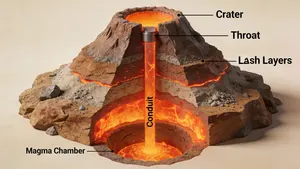
A 3D cutaway diagram of a volcano, showing its internal structure. The diagram should clearly label the magma chamber, conduit, throat, crater, and layers of ash and lava. The style should be a clean, technical illustration, with realistic textures for the rock and magma. This demonstrates the ability to generate accurate, science-based visuals for educational purposes, requiring strong spatial and scientific reasoning. –ar 16:9
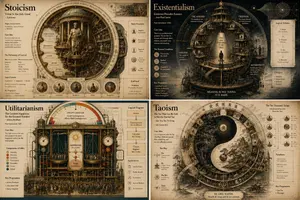
Philosophical Infographic Machine Generator
2x2 grid, 16:9, do this for 4 famous philosophies: class Philosophical_Idea_Machine_DNA: def __init__(self): self.subject = "[PHILOSOPHY / CONCEPT / PARADOX] (subject)" self.parents = { "composition_parent": "Renaissance memory theatre — wheels within wheels, concentric knowledge rings, symbolic emblems", "atmosphere_parent": "Alchemical manuscript — cryptic imagery, lunar light, sepia and oxidized copper tones", "graphic_parent": "Bauhaus conceptualism — elemental shapes as thought-forms, clean lines, primary colour logic", "detail_parent": "Encyclopédie plate — mechanical cross-sections of ideas, gears of dialectic, part numbering" } self.mutations = { "medium_mutation": "Printed layers of translucent vellum overlays that build the idea when viewed together", "information_mutation": "Logical syllogisms as circuit diagrams, historical proponents as constellation maps, glossary of terms", "semantic_mutation": "The abstract idea becomes a physical, inhabitable clockwork universe", "scale_mutation": "A single logical step unfolds into a complete microcosmic city where the idea is lived reality" } self. style_mix = { "composition_parent": 0.25, "atmosphere_parent": 0.20, "graphic_parent": 0.30, "detail_parent": 0.15, "mutations": 0.10 } def generate_subject(self): subject = """ Create a vertical luxury infographic poster that gives physical form to [SUBJECT]. Invent a magnificent symbolic machine, diagram, or architecture that represents the idea. Explode its layers to show internal logic, historical influences, counterarguments, and real-world manifestations. The design must feel like a transmission from a library that exists outside time. Semantic inference should render the intangible tangible with intellectual rigour. """ return render( subject, style_mix=self. style_mix, format="vertical poster, conceptual infographic", typography=""" Large title: [CONCEPT NAME] (concept name) Subtitle: [ORIGIN / PHILOSOPHER / MAXIM] Microtext: [LOGICAL FORMULA / CITATION / FIRST USE DATE / LATIN TERM] """, composition=""" Mandala-like symmetry or dynamic tension depending on concept nature. Clear visual hierarchy, meditative spacing. """, lighting=""" Illumination from unseen source — like a page from a sacred text held to candlelight. """, constraints=""" No trite symbols (lightbulbs for ideas, etc.). No pseudo-profound emptiness. """ )3a:Tb97,2x2
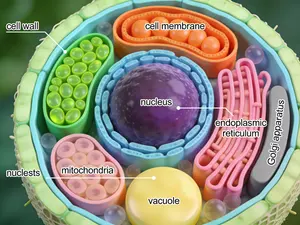
Scientific Plant Cell Illustration
A detailed, scientific illustration of a plant cell, in the style of a modern biology textbook. The illustration should be a 3D cross-section, clearly showing and labeling the cell wall, cell membrane, nucleus, chloroplasts, and other organelles. The colors should be clear and distinct for each organelle. This requires accurate, knowledge-based rendering for scientific education. –ar 4:3
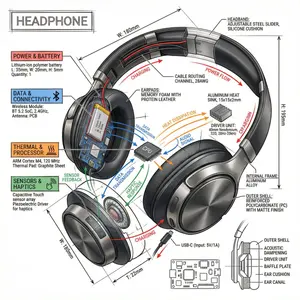
Technical Infographic Prompt Template - Nano Banana Pro AI Prompt for Infographic / Edu Visual
Create a technical infographic of OBJECT (object) with a 45-degree isometric 3D perspective showing the device slightly tilted to reveal depth and dimension. Combine a realistic photoreal render with black ink technical annotations on pure white background. Include: Key component labels with color-coded callout boxes Internal component visibility through transparent/cutaway sections Measurements, dimensions, and precise scale markers Material callouts and quantities Color-coded arrows for function/flow: RED (power/battery), BLUE (data/connectivity), ORANGE (thermal/processor), GREEN (sensors/haptics) Simple schematics or cross-sectional diagrams where relevant Place “OBJECT” title in a hand-drawn technical box (top-left corner). Style: Black linework (technical pen/architectural), sketched but precise. Object remains clearly visible. Educational museum-exhibit vibe. Clean composition, balanced negative space. Perspective: Isometric 3D angle—tilted to show depth, dimension, and internal architecture dramatically. Like a professional product teardown or engineering manual. Colors: ~10-15% accent density. Black dominant. White background. Output: 1080×1080, ultra-crisp, social-feed optimized.3e:T4da
Explore more prompts
Browse more AI image and video prompts by category.
FAQ
- How are the four paper worlds kept seamless without visible seams?
- The prompt explicitly requires the quadrants to touch directly with no grey background, borders or gaps while filling the entire frame with continuous paper details.
- Why does the Google quadrant emphasize stacked paper sheets over smooth surfaces?
- To create a sediment-canyon or contour-map effect using hundreds of thin colored sheets with visible fibers and cut edges instead of plastic-like finishes.