
Text to Image
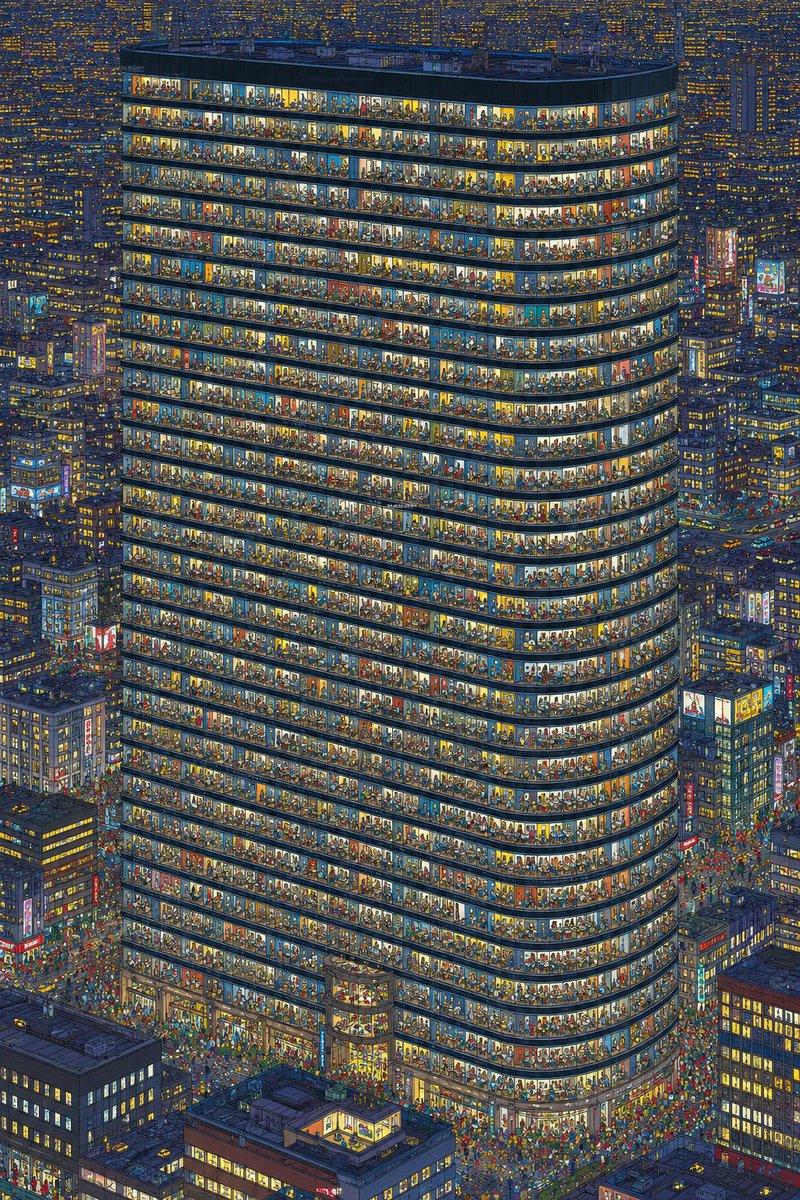
Crowded Night Office Tower — AI Image Prompt
Generates a highly detailed nighttime city illustration of a glass office tower packed with countless visible people for visual counting or observation challenges. - AIPinMaker
Prompt
Create an ultra-detailed nighttime isometric city illustration centered on one enormous rounded-corner office tower, viewed from a high aerial angle, with the facade cut open through continuous glass windows so every floor is visible. The tower should have exactly 34 visible occupied horizontal office floors, each floor packed with tiny individual people, desks, chairs, lamps, partitions, plants, shelves, meeting rooms, and colorful interior details; make the crowd density extreme, like a visual counting challenge, with hundreds or thousands of miniature figures visible through the windows. Use {argument name="building shape" default="a tall rounded rectangular glass office tower with curved corners"} as the main subject. Surround it with a dense cyberpunk-like metropolis of shorter high-rise buildings, glowing windows, neon signs, street traffic, and crowds at street level. Lighting is nighttime blue with warm yellow, orange, and white office lights, creating a strong contrast between the dark city and the brightly illuminated tower interiors. The style should be intricate hand-drawn architectural illustration with crisp linework, dense micro-detail, slightly painterly colors, and no empty areas. The image should be vertical, poster-like, packed edge to edge with buildings and tiny people. Add a busy entrance plaza and streets around the base filled with many tiny pedestrians and vehicles, but keep the main tower dominant and centered. Do not include readable text, logos, watermarks, or UI elements. Emphasize that every window bay contains distinct tiny scenes and visible human silhouettes for counting.Prompt breakdown
- Subject
- enormous rounded-corner office tower with exactly 34 visible occupied floors packed with tiny people, desks, chairs, lamps, partitions, plants, shelves, meeting rooms, and colorful details
- Style
- intricate hand-drawn architectural illustration with crisp linework, dense micro-detail, slightly painterly colors, and no empty areas
- Lighting
- nighttime blue ambient with warm yellow, orange, and white office lights creating strong contrast between dark city and illuminated interiors
- Composition
- vertical poster-like format, high aerial isometric angle, main tower centered and dominant with surrounding buildings and plaza filling the frame edge to edge
- Mood
- bustling extreme density like a visual counting challenge, vibrant interior activity against the dark cyberpunk metropolis
Remix ideas
- change to 25 floors while keeping the same cut-open glass facade and crowd density
- replace the cyberpunk surroundings with more muted brutalist concrete towers and sodium streetlights
- tilt the isometric angle slightly lower to emphasize the busy entrance plaza pedestrians and vehicles
Reference images
How to use this AI Image prompt template
 1
1Copy the prompt — grab this template’s prompt and negative prompt.  2
2Pick a model — choose a recommended AI model for the best match.  3
3Generate — open the studio with one click and create your result.
Related templates

Historical Era Bedroom Interior Map
Create a creative image of Historical Era Bedroom Interior Map. Style: photorealistic. Composition: balanced and well-framed. Lighting: natural with cinematic mood. Category: photography. Reference: historical-era-bedroom-interior-map-18763.

Isometric Exploded Urban Asset Sheet
A massive isometric exploded-view environment sheet showing a dense collection of modular retro urban buildings and room cutaways on a clean white background, rendered like a highly detailed game asset breakdown or architectural kitbash catalog. The image contains 20 main assembled structures or room modules, each separated into floating parts: 1 small gabled house with blue roof, 1 dark blue square building, 1 small rust-red house, 1 cylindrical weathered tower building, 1 white two-story house with blue roofs, 1 warm wood-paneled corner room, 1 compact study or office room, 1 bedroom, 1 dining room with balcony, 1 café or kitchen room, 1 narrow storefront room, 1 small lit alcove room, 1 large concrete stairwell block, 1 small tiled washroom, 1 medium concrete stair-and-landing block, 1 larger concrete stair platform block, 1 narrow concrete corridor or service block, 1 large empty concrete room, and 1 blue vending machine pair area. Surrounding all modules are hundreds of separated components arranged neatly in exploded fashion: roof panels, corrugated awnings, wall segments, doors, shutters, windows, stair flights, railings, balconies, signboards, pipes, antennas, utility poles, lamps, vents, meters, tanks, planters, flower boxes, benches, crates, air conditioners, cabinets, fences, street barriers, buckets, jars, utility boxes, and small street props. The style is painterly but precise, with cozy amber interior lighting contrasting against worn concrete, oxidized metal, chipped paint, rust-red and deep blue roofs, teal-green trim, and aged urban textures. Emphasize miniature diorama realism, isometric perspective, exploded assembly presentation, many floating parts evenly spaced around each structure, highly legible silhouette separation, soft studio shadowing, extremely intricate detail, concept-art polish, and the feeling of a comprehensive environment asset sheet for a side-street neighborhood in a nostalgic Japanese retro urban district (city style). Include exactly 20 major modules, with the lower edge lined by many small props and potted plants, and keep the overall composition balanced across the full canvas. Use a crisp white background, no framing, no people, no vehicles except 1 bicycle, and no text labels.3
Arboreal Architecture Presentation Board
Ultra-realistic architectural competition presentation board, portrait A1 layout, 4K resolution, mixed media visualization SHEET COMPOSITION: Full architectural board layout with balanced visual hierarchy. Top-third: large detailed 2D front elevation with fine linework, grid lines, section markers, and dimensional annotations in millimeters. Center-left: side and rear elevations in precise white technical drafting. Center-right: 3D isometric views and exploded axonometric component diagrams. Bottom section: concept development diagrams, design idea sketches, structural annotations, material palette callouts with timber / exposed concrete / glass labels, human scale reference figures, and landscape integration drawings. Modern architectural typography, minimal clean labeling. Negative space used intentionally for breathing room. Blueprint overlay fading at edges. ARCHITECTURE TREE-INSPIRED MODERN CONCEPTUAL HOUSE: Organic branching structural columns mimicking tree trunks and limbs, cantilevered volumes projecting asymmetrically, full-height glass curtain walls with slim mullions, exposed board-formed concrete cores, warm-toned timber cladding panels, green terraces cascading at each floor level, rooftop garden with native planting, elevated platform volumes integrated between existing trees, natural cross-ventilation cutaways shown in section, passive solar and sustainable strategy diagrams annotated with arrows, floor plan levels clearly marked, structural grid expressed through glazing. 3D RENDERING QUALITY: Photorealistic materials wet concrete catching light, timber with visible grain, reflective wet stone paving, glass reflecting stormy sky dramatic warm amber interior glow bleeding through floor-to-ceiling glazing, high contrast shadows, cinematic environmental depth, ultra-sharp drafting lines overlaid on realistic render textures, Zaha Hadid / BIG / Kengo Kuma (architectural style) competition board aesthetic. ATMOSPHERE: Dark stormy sky, heavy overcast with volumetric fog and mist rolling through trees (weather atmosphere), moody cinematic lighting, soft rain-wet reflective ground surfaces, deep shadow gradients, warm glowing interiors contrasting cold exterior environment, dramatic chiaroscuro, photorealistic environmental depth. BACKGROUND & BOARD TEXTURE: Charcoal and deep graphite toned paper texture, subtle blueprint grid lines fading behind drawings, faint construction reference lines, elegant monochromatic palette blacks, greys, off-whites with selective warm amber and timber-tone highlights, no clutter, premium studio presentation quality. STYLE REFERENCES: Architectural competition panel, mixed media board, Kengo Kuma material sensitivity, BIG diagram clarity, Zaha Hadid parame
City tallest buildings 3D cartoon showcase prompt - Nano Banana Pro AI Prompt for Infographic / Edu Visual
Present a clear, side miniature 3D cartoon view of YOUR CITY (city) tallest buildings. Use minimal textures with realistic materials and soft, lifelike lighting and shadows. Use a clean, minimalistic composition showing exactly the three tallest buildings in Sopot (reference city), arranged from LEFT to RIGHT in STRICT descending height order. The tallest must appear visibly tallest, the second must be clearly shorter than the first, and the third must be clearly shorter than the second. All buildings must follow accurate relative proportions: if a building is taller in real life, it MUST be taller in the image by the same approximate ratio. No building may be visually stretched or compressed. Each building should stand separately on a thin, simple ceramic base. Below each base, centered text should display: Height in meters — semibold sans-serif, medium size Year built — lighter-weight sans-serif, smaller size, directly beneath the height text Provide consistent padding, spacing, leading, and kerning. Write “YOUR CITY NAME (city name text)” centered above the buildings, using a medium-sized sans-serif font. No building top should overlap or touch the text above.Use accurate architectural proportions based on real-world references.Maintain consistent camera angle and identical scale for each building model. No forced perspective. Use straight-on orthographic-style rendering. Do not exaggerate or stylize size differences beyond proportional accuracy. Use a square 1080×1080 composition.Use a clean, neutral background. Ensure no extra objects are present.3f:T6a5,P
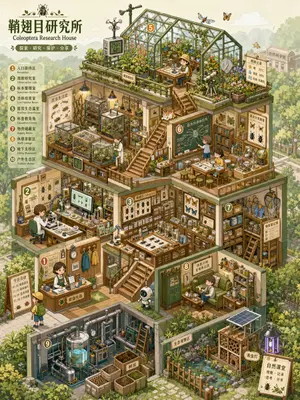
Isometric Micro-World Cross-Section Archive
请根据【主题】创作一张高完成度、高信息密度、适合系列化发布的「微缩世界剖面馆 / Isometric Micro-World Archive」视觉图。 这不是普通房间插画,也不是单纯的建筑图,而是一张结合“等距轴测视角 + 建筑剖面结构 + 多层功能空间 + 高密度主题道具 + 微缩模型感 + 游戏场景设定集感”的主题空间总览图。画面需要像一个被剖开的微缩世界、经营模拟游戏场景、玩具屋模型或世界观设定图,让观者可以一眼看懂整体结构,又能反复观察其中的小细节。 【基础设定】 主题:【主题,例如昆虫研究所 / 未来生存基地 / 魔法药剂工坊 / AI自动化公司 / 植物工厂 / 儿童学习中心 / 太空补给站】 空间名称 / 品牌名:【品牌名或空间名称,可为空】 世界观方向:【现实 / 科幻 / 童话 / 魔法 / 末日 / 博物馆 / 实验室 / 经营模拟 / 校园 / 自然生态】 建筑类型:【小屋 / 基地 / 工厂 / 实验室 / 商店 / 博物馆 / 地下空间 / 飞船 / 多层工作室】 核心功能:【这个空间主要用来做什么,例如研究、生产、展示、生活、训练、交易、学习、维修、种植】 主色调:【主色调,例如浅蓝、薄荷绿、奶油黄、粉色、橙绿、紫蓝、白蓝科技色】 辅助色:【辅助色,可为空】 点缀色:【点缀色,可为空】 画幅比例:【1:1 / 3:4 / 4:5 / 9:16】 信息密度:【中高密度 / 高密度 / 超高密度】 整体气质:【治愈、可爱、精密、童趣、科普、未来感、复古、清爽、探索感】 如果某些字段没有填写,请根据【主题】自动合理推导,不要让画面留空。所有内容都要围绕主题统一生成,避免加入无关元素。 【画面结构】 采用清晰的等距轴测视角 / isometric view / axonometric view,主体是一个被剖开的多层主题建筑或功能基地。观者可以同时看到建筑的正面、侧面、顶面和内部空间。整体建筑位于画面中心,占据画面主要面积,背景环境适度淡化,用来衬托主体。 建筑内部需要分成多个功能区域,每个区域都要有明确用途,而不是随机堆放装饰。可以包含: 1. 主工作区 / 核心操作区 2. 展示区 / 收藏区 / 标本区 3. 研究区 / 实验区 / 控制区 4. 储藏区 / 货架区 / 物资区 5. 生活区 / 休息区 / 小型居住区 6. 能源区 / 机器区 / 管道区 7. 种植区 / 培养区 / 生态区 8. 入口区 / 运输区 / 维修区 9. 楼梯、平台、走廊、栏杆、梯子等空间连接结构 各个区域之间要通过楼梯、走廊、平台、管道、桥架或电缆形成清晰的空间关系,让画面像一个真实可以运转的小型系统。 【道具与细节】 根据【主题】生成大量相关道具,并让它们分布在不同功能区中。道具需要具体、可识别、有主题关联,不能只是泛泛的装饰。每个小物件都应像游戏资产一样清晰可读,具有可点击、可互动、可收集的感觉。 道具类型可以包括: - 主题设备:机器、仪器、工具、控制台、容器、屏幕、工作台 - 生活物件:桌椅、书架、床铺、杯子、箱子、柜子、灯具 - 展示物件:标本、模型、海报、说明牌、玻璃柜、陈列架 - 连接结构:管道、电线、梯子、楼梯、输送带、滑轨、平台 - 生态元素:植物、水箱、培养箱、土壤、树枝、岩石、标本 - 角色元素:少量小人物、小动物、机器人或主题生物,用来提供尺度感和故事感 道具数量要丰富,但要保持秩序。所有道具都应服务于空间功能和主题世界观。 【风格要求】 整体风格为清晰、可爱、精密的手绘卡通等距插画。线条干净,边缘略圆润,色彩明亮柔和,整体具有轻松、治愈、探索感。画面应有经营模拟游戏、儿童科普绘本、微缩模型、设定集页面的感觉。 避免过度写实,避免强烈暗黑光影,避免厚重油画感,避免复杂噪点。重点是清楚、精致、有层次、可读性强。 【颜色与光影】 使用高明度、低到中等饱和度的柔和配色。主色调统一,辅助色用于区分不同空间,点缀色用于突出关键设备和小道具。线稿颜色不要使用死黑,可使用深灰、蓝灰、棕灰等柔和描边。 光影保持轻量,不需要强烈真实投影。通过色块、结构、线条和局部高亮来建立层次。背景使用浅色、低对比度处理,使主体建筑更加突出。 【构图与阅读路径】 画面主体居中或略微偏上,建筑呈多层剖面结构。视觉阅读路径应从整体建筑轮廓开始,再进入各楼层功能区,最后观察细节道具。可以通过楼梯、平台、走廊、管线、轨道等元素引导视线。 整体画面要饱满但不拥挤,丰富但不混乱。每个房间、平台和角落都应该有内容,但仍然保持清晰的空间边界。 【背景环境】 背景可以根据主题加入弱化的外部环境,例如森林、城市、街道、地下岩层、实验园区、海底、太空、校园、工厂外墙等。背景不要抢主体,建议使用淡色、低透明度、低对比度处理,形成“主体清晰、背景退后”的效果。 【最终效果】 最终画面应像一张完整的主题空间设定图,既有建筑剖面图的结构感,又有游戏场景资产图的细节感,还带有微缩玩具屋的可爱探索感。它应该适合用于系列化视觉创作、IP世界观展示、游戏场景设定、品牌空间概念图、科普内容封面或小红书/Pinterest风格视觉发布。 请确保画面: 1. 等距轴测视角明确 2. 建筑剖面结构清楚 3. 多层功能区完整 4. 道具丰富且主题统一 5. 色彩柔和明亮 6. 线稿清晰干净 7. 背景弱化、主体突出 8. 信息密度高但不混乱 9. 具有可探索、可运营、可反复观察的微缩世界感3d:T1cc3,Please create a high-completion, high-information-density visual map of an 'Isometric Micro-World Archive' suitable for serialized publishing based on the [Theme]. This is not a regular room illustration or a simple architectural drawing, but a thematic space overview combining 'isometric perspective + architectural cross-section structure + multi-layer functional space + high-density thematic props + miniature model feel + game scene concept art feel.' The image should look like an opened miniature world, a business simulation game scene, a dollhouse model, or a world-building concept map, allowing viewers to understand the overall structure at a glance while repeatedly observing the small details within. [Basic Settings] Theme: [Theme, e.g., Insect Research Institute / Future Survival Base / Magic Potion Workshop / AI Automation Company / Plant Factory / Children's Learning Center / Space Supply Station] Space Name / Brand Name: [Brand name or space name, can be empty] Worldview Direction: [Reality / Sci-Fi / Fairy Tale / Magic / Post-Apocalyptic / Museum / Laboratory / Business Simulation / Campus / Natural Ecology] Building Type: [Cottage / Base / Factory / Lab / Shop / Museum / Underground Space / Spaceship / Multi-layer Studio] Core Function: [What this space is mainly used for, e.g., research, production, display, life, training, trading, learning, maintenance, planting] Main Color: [Main color, e.g., light blue, mint green, cream yellow, pink, orange-green, purple-blue, white-blue tech color] Auxiliary Color: [Auxiliary color, can be empty] Accent Color: [Accent color, can be empty] Aspect Ratio: [1:1 / 3:4 / 4:5 / 9:16] Information Density: [Medium-high / High / Ultra-high] Overall Vibe: [Healing, cute, precise, childlike, popular science, futuristic, retro, refreshing, sense of exploration] If some fields are not filled, please automatically derive them reasonably based on the [Theme]; do not leave the screen blank. All content must be generated uniformly around the theme, avoiding irrelevant elements. [Visual Structure] Adopt a clear isometric perspective / axonometric view, where the main subject is an opened multi-layer thematic building or functional base. Viewers can simultaneously see the front, side, top, and internal space of the building. The entire building is located at the center of the screen, occupying most of the area, with the background environment moderately faded to highlight the subject. The interior of the building needs to be divided into multiple functional areas, each with a clear purpose, rather than randomly piled decorations. It can include: 1. Main work area / Core operation area 2. Display area / Collection area / Specimen area 3. Research area / Lab area / Control area 4. Storage area / Shelving area / Supply area 5. Living area / Rest area / Small residential area 6. Energy area / Machine area / Piping area 7. Planting area / Cultivation area / Ecological area 8. Entrance area / Transport area / Maintenance area 9. Spatial connection structures like stairs, platforms, corridors, railings, ladders, etc. Clear spatial relationships must be formed between various areas through stairs, corridors, platforms, pipes, bridges, or cables, making the image look like a real, functioning miniature system. [Props and Details] Generate a large number of relevant props based on the [Theme] and distribute them in different functional areas. Props need to be specific, identifiable, and thematically related, not just vague decorations. Each small object should be as clear and readable as a game asset, with a feel of being clickable, interactive, and collectable. Types of props can include: - Thematic equipment: machines, instruments, tools, consoles, containers, screens, workbenche

8-Panel Palace Hall Construction Board
{"type":"architectural construction storyboard","subject":{"building":"{argument name=\"building name\" default=\"traditional Chinese palace hall\"}","style":"historic East Asian timber palace architecture, monumental ceremonial hall on a high stone platform","environment":"plain light studio background with only the building base and immediate platform, no surrounding city, no unrelated scenery"},"camera":{"view":"consistent isometric high three-quarter view from the front","composition":"centered and symmetrical in every panel","lighting":"soft neutral studio lighting","rendering":"high-detail architectural model illustration, clean presentation board aesthetic, realistic materials"},"layout":{"grid":{"rows":2,"columns":4},"sections":[{"title":"panel 1","position":"top-left","count":1,"labels":["empty raised stone platform with beveled perimeter"]},{"title":"panel 2","position":"top-center-left","count":1,"labels":["platform gains central ceremonial stairway, side stairs, and upper terrace forms"]},{"title":"panel 3","position":"top-center-right","count":1,"labels":["stone balustrades and terrace railings added around the platform"]},{"title":"panel 4","position":"top-right","count":1,"labels":["red timber columns and main wooden frame erected on the rear upper platform"]},{"title":"panel 5","position":"bottom-left","count":1,"labels":["dense bracket sets, crossbeams, and upper structural framework assembled"]},{"title":"panel 6","position":"bottom-center-left","count":1,"labels":["large roof skeleton and layered eaves structure formed"]},{"title":"panel 7","position":"bottom-center-right","count":1,"labels":["golden roof covering installed while some upper structure remains exposed"]},{"title":"panel 8","position":"bottom-right","count":1,"labels":["fully completed palace hall with finished tiled roof and decorated eaves"]}],"total panels":8},"design details":{"base":"light gray carved stone platform with broad central ramp, multiple stair flights, and symmetrical stepped terraces","structure":"vermillion red columns, dark wood beams, intricate blue-green dougong brackets, layered timber framing","roof":"double-eaved sweeping hip roof with golden glazed tiles, slightly upturned corners, ridge ornaments","color palette":"light gray stone, rich red columns, brown timber, blue-green bracket accents, warm golden roof"},"constraints":["no people","no vehicles","no modern machinery","no scaffolding","no labels or captions inside the image","no unrelated buildings","no large landscape background"],"goal":"show a clear 8-step progression from bare foundation to completed ceremonial palace building, with each panel visibly advancing the construction stage and panel 7 distinctly less finished than panel 8"}
Explore more prompts
Browse more AI image and video prompts by category.
FAQ
- How does the prompt ensure every window shows distinct activity?
- It specifies that every window bay must contain distinct tiny scenes and visible human silhouettes across all 34 floors, creating the extreme counting-challenge density.
- What keeps the main tower dominant in the vertical composition?
- The prompt centers the enormous rounded-corner tower while surrounding it with shorter buildings, a filled plaza, and streets, ensuring the 34-floor interior remains the clear focal point.