
テキストから画像
Fictional World Map Attempts Collage — AI 画像プロンプト
Generates a zoomed-out contact sheet of many failed futuristic fictional world map variations for creative worldbuilding. - AIPinMaker
プロンプト
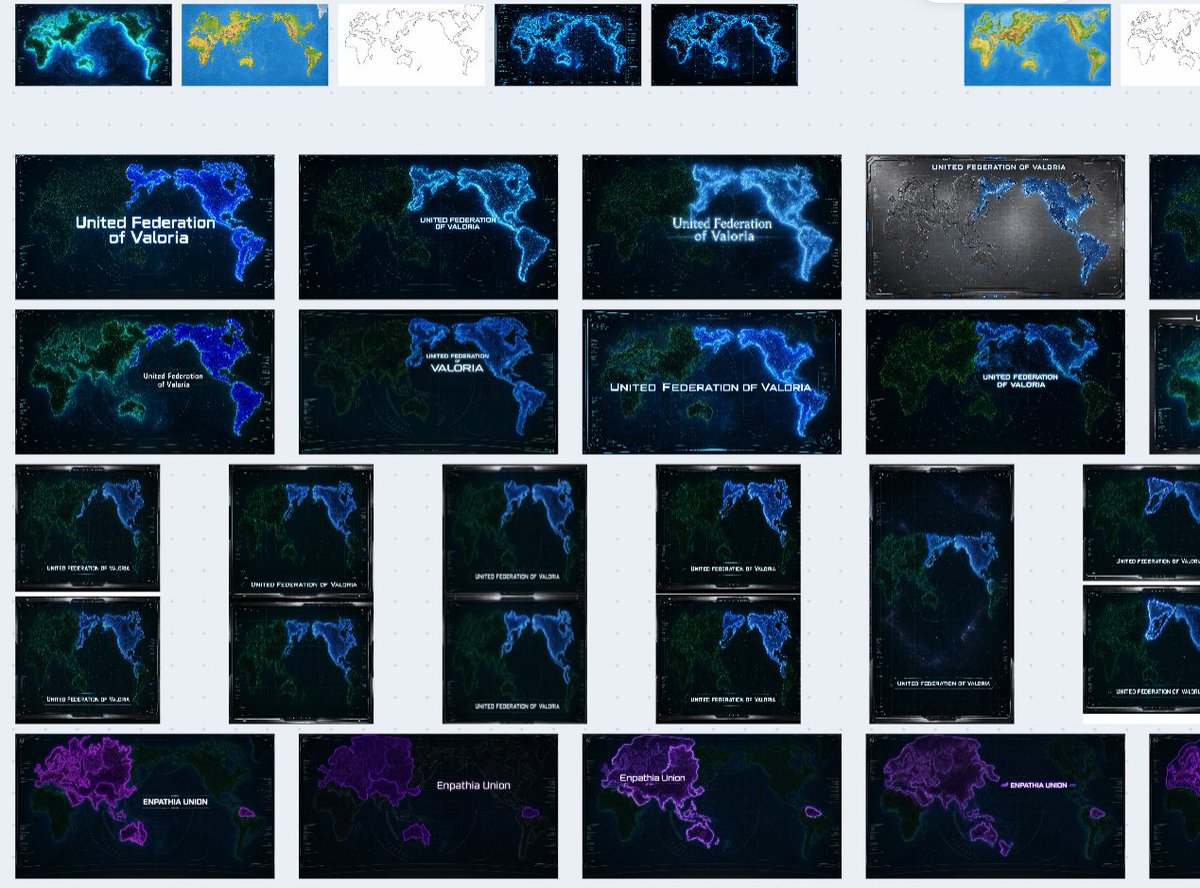
Goal: Create a screenshot-like collage showing a pile of unusable AI-generated fictional world map attempts on a pale gray workspace, as if viewed on an image-generation history board. The subject is not one map, but a messy contact sheet of many map thumbnails for a future fictional nation.

Canvas: Wide 16:10 landscape canvas, light gray background with a faint dotted grid pattern. Leave generous gutters between thumbnails. The entire composition should feel like a zoomed-out browser or design-board view, with some thumbnails cut off by the right edge.

Layout: Arrange exactly 35 visible map thumbnails in an irregular grid. Count them as: 8 small thumbnails across the top row, 10 large landscape thumbnails in the middle two rows, 12 smaller portrait/landscape thumbnails in the lower middle arranged in paired columns, and 5 large purple-themed thumbnails along the bottom row. Include several partially cropped thumbnails on the far right edge to imply the board continues off-screen.

Thumbnail content: Each thumbnail is a different failed variation of a futuristic world map for {argument name="fictional nation name" default="United Federation of Valoria"}. Most maps show altered Earth-like continents but not an accurate real-world map. Use dark navy or black ocean backgrounds, neon blue coastlines, cyan glowing borders, faint green landmasses, satellite-map textures, grid overlays, small HUD-like ticks, and occasional white title text. Some thumbnails should look like color tests: one bright blue-and-yellow terrain map, one simple black-outline map on white, and multiple glowing cyberpunk versions. The bottom row should use a different purple faction label, {argument name="bottom faction name" default="Empathia Union"}, with purple-highlighted landmasses around Eurasia/Australia-like shapes.

Visible labels: Repeat the title text on many thumbnails, usually centered or near the lower third, reading {argument name="main map label" default="United Federation of Valoria"}. Vary the typography and size slightly so some labels are tiny, misaligned, or awkwardly placed. Bottom-row thumbnails should instead read {argument name="purple map label" default="Empathia Union"}. A few labels may be partially illegible due to scale, cropping, or glow.

Visual style: Make it look like a collection of generated image results, not a polished infographic. Use inconsistent map compositions, inconsistent coastline shapes, different zoom levels, different title placements, and slightly mismatched aspect ratios. The dominant palette is black, deep navy, electric cyan, blue, green, and purple, with occasional white thumbnails and one or two bright terrain-map thumbnails.

Constraints: Do not create a single clean world map. Do not make the continents match the real Earth exactly. Do not add people, UI controls, large captions, watermarks, or a polished final design. Preserve the feeling of many discarded attempts scattered on a pale dotted canvas.参照画像
このAI画像プロンプトテンプレートの使い方
 1
1プロンプトをコピー — テンプレートのプロンプトとネガティブプロンプトを取得。  2
2モデルを選ぶ — 最適な推奨AIモデルを選択。  3
3生成 — ワンクリックでスタジオを開いて作成。
関連テンプレート

AAA Fighting Game Storyboard Grid
{ "instruction": "Use the provided two character images as exact visual references. Preserve identity, face, outfit, proportions, and details perfectly.", "concept": "AAA fighting game scene presented as a Tekken-style gameplay grid storyboard (game concept)", "layout": { "type": "3x3 grid", "description": "nine panels showing a continuous fight progression with full game UI visible in each frame" }, "panels": [ "panel 1: dramatic VS screen — character A vs character B, both facing each other, glowing background, versus text in center", "panel 2: round start — both fighters in idle stance, READY text on screen", "panel 3: FIGHT moment — cinematic spark explosion as fight begins", "panel 4: first attack — character A throws a punch with motion blur", "panel 5: counter attack — character B kicks with impact sparks", "panel 6: combo sequence — multiple hit sparks, motion trails, dynamic camera", "panel 7: low health moment — health bar flashing red, tension moment", "panel 8: finishing move — slow motion heavy hit, cinematic angle", "panel 9: KO screen — opponent falling back, huge KO text, particles flying" ], "style": "ultra realistic AAA Tekken-style fighting game, cinematic gameplay rendering, highly detailed characters, realistic lighting (art style)", "camera": "in-game fighting camera, slightly angled side view, dynamic zoom during impacts", "environment": "high-end fighting arena, dark background with neon accents, subtle depth, not distracting", "ui_elements": { "health_bars": "top left and right, detailed, glowing, decreasing across panels", "timer": "center top", "player_names": "top left and right", "round_indicator": "visible", "combo_counter": "appears during hits", "hit_effects": "sparks, flashes, light streaks", "KO_text": "large, bold, center screen in final panel", "READY_FIGHT_text": "arcade-style bold typography" }, "effects": [ "motion blur on attacks", "impact sparks", "energy trails", "camera shake effect", "slow motion feeling in finishing hit", "screen glow during hits" ], "color_grading": "high contrast, arcade cinematic, vibrant highlights, deep shadows (color grading)", "output": "clean 3x3 grid, perfectly aligned panels, full UI visible, no logos, no watermarks" } "reference_style": "Tekken 8 gameplay UI, arcade fighting game interface, modern AAA fighting HUD"39:T9f9,{ "instr
Cinematic Floral Mountain Biker
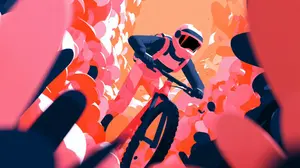
Create a dynamic cinematic digital illustration of a mountain biker (subject) racing downhill through a tunnel-like canyon of dense abstract flower petals and rounded foliage shapes. Use an extreme low-angle wide shot from directly in front of the bike, with the oversized front tire dominating the lower center foreground and the rider leaning aggressively forward over the handlebars. The rider wears a sleek full-face helmet with a black reflective visor, a fitted futuristic cycling suit in hot pink, coral, and deep navy (rider colors), gloves, and protective gear. Surround the scene with thick walls of stylized petals and leaf silhouettes in vivid pink, red, coral, orange, and white (environment colors), forming a rushing corridor that suggests speed and motion. Add large blurred foreground petal shapes on the left and right edges for depth, dark navy shadow shapes for contrast, and a warm peach-orange glowing background at the vanishing point. The style should be highly aesthetic, bold, graphic, semi-abstract, with smooth vector-like shapes, painterly gradients, dramatic foreshortening, high saturation, strong rim lighting, motion energy, and no visible text.
Two-Step Power Release Transformation Prompt (Japanese) - Nano Banana Pro AI Prompt for Comic / Storyboard
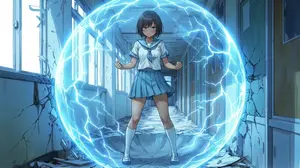
【覚醒ポーズプロンプト】 subject: > Use the same character as reference A. Preserve all facial features, hairstyle, clothing, body proportions, colors, line weight, shading, and art style exactly as in the reference. composition: > IMPORTANT: Change the framing from the reference. The camera must be positioned **much farther away** so the character’s entire body is fully visible **with extra space above, below, and around** the character. The character must appear **significantly smaller** than in reference A, occupying only about **20–30% of the frame height**. Place the character exactly at the center of the frame with wide open space surrounding them for later energy effects. The field of view should be noticeably wider than the reference. The final image must be rendered in a **16:9 aspect ratio**. action: > Set the character in the awakening stance shown in reference B: - feet shoulder-width apart - both hands tightly clenched into fists - arms slightly bent and tense - chest slightly forward, posture firm and braced - intense, focused expression location: > Reuse the same background environment as reference A. Expand the visible portion of the background **significantly** to match the widened, zoomed-out framing. Maintain the same textures, perspective, colors, and drawing style. style: > Match the exact style of reference A: identical linework, shading, coloring, and background rendering. camera_lighting: > Use the same lighting conditions as in reference A. edit_instructions: > Recreate the character and background from reference A exactly. BUT modify the camera distance so the entire character fits in the frame with **substantial space** around them. The camera should be pulled back enough that the character appears small within a much wider environment. Change only: - the camera distance (strong zoom out) - the char40:T7c2,[Awakening Pose Prompt] subject: > Use the same character
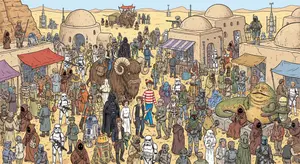
Where’s Waldo Star Wars scene
Create a cinematic image of Wheres Waldo Star Wars Scene. Style: photorealistic. Composition: balanced and well-framed. Lighting: natural with cinematic mood. Category: cinematic-video. Reference: wheres-waldo-star-wars-scene-39.

3D Exploded Assembly Drawing
Goal: Create an ultra-wide, extremely information-dense panoramic illustrated timeline of the entire universe, Earth, life, human civilization, technology, and the future, rendered as a single seamless epic cross-section mural for gpt-image-2. Canvas: 16:9 horizontal poster, very high detail, cinematic realism mixed with museum-quality educational illustration, sharp enough to read tiny timeline labels. Use a grand curved horizon of Earth across the center, with outer space above and layered historical scenes below. No blank areas. Overall layout: The composition is divided into 4 main horizontal zones. Top zone: cosmic history in deep space. Upper-middle zone: Earth history and natural evolution across a sweeping landscape. Lower-middle zone: human civilization and technological progress. Bottom zone: a continuous golden timeline strip with exactly 18 labeled milestones in Chinese, each with a small circular marker. Top cosmic zone: Show a fiery Big Bang explosion at far left, colorful nebulae and starfields, a spiral galaxy, forming planets, the solar system, Earth and Moon, asteroids and comets, rockets, satellites, a space station, astronauts on the Moon, lunar rover, Mars rover, futuristic space telescopes, spacecraft, a ring station, distant planets, black hole, and blue laser-like space trails at far right. Add a thin golden orbital timeline line with small circular nodes crossing this upper area. Upper-middle Earth and evolution zone: Blend volcanic early Earth on the left with lightning, lava, meteor impacts, hot oceans, microbial bubbles and sea creatures; transition into lush prehistoric seas with fish, ammonites, trilobites, and marine reptiles; continue into a dinosaur landscape with forests, sauropods, theropods, pterosaurs, and smaller dinosaurs; transition to ice-age mountains and mammoths; then to modern rivers, grasslands, elephants, deer, birds, wind turbines, farmland, and a sleek futuristic city skyline at the right. Keep the transitions seamless like a chronological world map. Lower-middle civilization and technology zone: At far left show human evolution silhouettes walking forward, early campfires, caves, stone tools, primitive huts, pottery, sheep and cattle. Continue through ancient agriculture, pyramids, temples, classical cities, pagodas, medieval castles, churches, marketplaces, sailing ships, caravans, early machines, steam trains, bicycles, automobiles, airplanes, factories with smokestacks, power lines, telephones, radios, televisions, computers, laptops, smartphones, servers, laboratories, control rooms, robots, holographic blue interfaces, high-speed trains, and futuristic glass cities. Include many tiny people in period clothing interacting naturally. Bottom strip: Create a dark blue-black footer band with a thin gold line and exactly 18 milestone nodes, evenly spaced left to right. Use these exact Chinese labels and dates, one per node: 1. 「宇宙诞生\n约138亿年前」, 2. 「太阳系形成\n约46亿年前」, 3. 「地球形成\n约45亿年前」, 4. 「生命起源\n约38亿年前」, 5. 「海洋生命\n约5.4亿年前」, 6. 「恐龙时代\n约2.3亿年前」, 7. 「哺乳动物时代\n约6600万年前」, 8. 「人类出现\n约300万年前」, 9. 「农业革命\n约1.2万年前」, 10. 「文明起源\n约公元前3500年」, 11. 「古典时代\n约公元前800年」, 12. 「中世纪\n约5世纪」, 13. 「大航海时代\n15–17世纪」, 14. 「工业革命\n18–19世纪」, 15. 「电气时代\n19–20世纪」, 16. 「信息时代\n20世纪后半叶」, 17. 「数字时代\n21世纪」, 18. 「未来探索\n未来」. Visual style: Hyper-detailed epic science-history infographic, realistic lighting, vibrant but coherent color grading, gold accent lines, deep blues and oranges, miniature diorama detail, cinematic depth, crisp micro-scenes, no cartoon style, no flat vector look. Constraints: Make the poster astonishingly dense but coherent; keep all 18 bottom labels legible; avoid random unreadable text outside the timeline; avoid duplicated milestone labels; do not add watermarks or logos. The main theme is the complete history of the universe, Earth, life, civilization, technology, and future exploration (timeline theme). Use Chinese (language for milestone labels) for the footer labels, a hyper-detailed cinematic educational mural (visual style), a gold (accent color), and a optimistic blue futuristic (future city mood).6c:T11f8,Goal: Create an ultra-wide, extremely information-dense panoramic illustrated timeline of the entire universe, Earth, life, human civilization, technology, and the future, rendered as a single seamless epic cross-section mural for gpt-image-2. Canvas: 16:9 horizontal poster, very high detail, cinematic realism mixed with museum-quality educatio

Water Margin Themed Flying Chess Board
Create a creative image of Water Margin Themed Flying Chess Board. Style: photorealistic. Composition: balanced and well-framed. Lighting: natural with cinematic mood. Category: photography. Reference: water-margin-themed-flying-chess-board-15936.
他のプロンプトを探す
カテゴリ別にAI画像・動画プロンプトをもっと見る。